All body parts
MRI Anatomy Flashcards · Angiography

Head / COW Anatomy

Learn to identify every labeled structure on a Head / COW MRI, plane by plane.

Studying as a guest, so progress saves on this device only.

Head / COW anatomy, structure by structure

Head / COW imaging is how you map the brain's blood supply, and reading it starts with knowing the normal Circle of Willis cold. This reference walks through every artery in our Head / COW flashcard deck as it appears on a 3D time-of-flight (TOF) MRA viewed as a maximum-intensity projection (MIP), across the coronal and sagittal projections, with a plain-language definition of each vessel's course, where it shows up on the MIP, and the vascular pathology you will actually run into at the scanner.

Anterior circulation

The carotid system that feeds the front of the brain. On the TOF MIP, trace the internal carotids up the skull base, then follow them forward into the anterior cerebrals and laterally into the middle cerebrals.

Internal Carotid Artery labeled on a Head / COW MRI (Sagittal)

Internal Carotid Artery

The main artery of the anterior circulation, ascending from the neck through the skull base to supply most of the cerebral hemisphere on its side.

On MRI: On the sagittal TOF MIP it is the large bright vessel sweeping up through the carotid canal and cavernous segment, making its characteristic S-shaped carotid siphon before branching into the anterior and middle cerebral arteries.

Common pathology: Atherosclerotic stenosis, dissection, and aneurysms at the cavernous and supraclinoid segments; occlusion threatens the entire anterior circulation territory.

Right Internal Carotid Artery labeled on a Head / COW MRI (Coronal)

Right Internal Carotid Artery

The right-sided internal carotid artery supplying the right anterior cerebral circulation.

On MRI: On the coronal TOF MIP it is the bright vessel ascending on the patient's right (image left), rising toward the right terminus where the anterior and middle cerebral arteries arise.

Common pathology: Right ICA stenosis or occlusion produces right-hemisphere ischemia; compare side to side for asymmetric caliber or signal dropout.

Tip: On a coronal MIP, patient right sits on the left of the image; confirm laterality before reporting which carotid is narrowed.

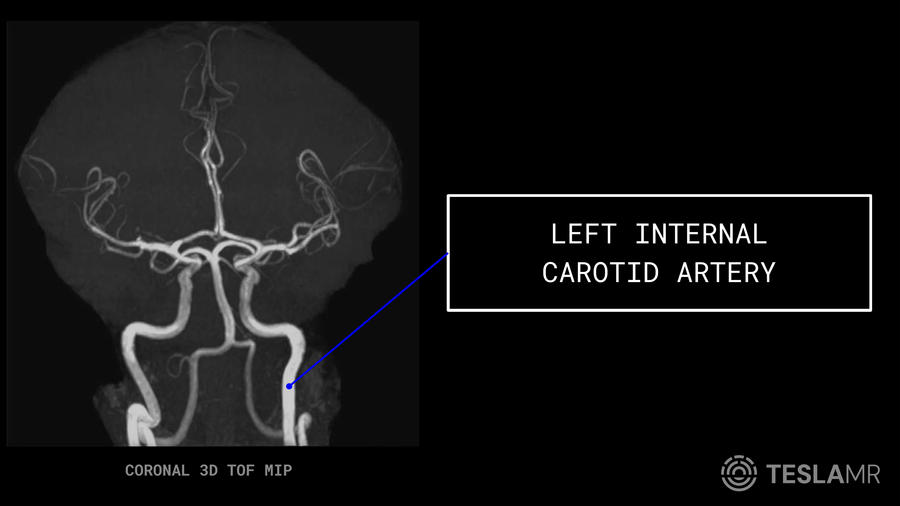
Left Internal Carotid Artery labeled on a Head / COW MRI (Coronal)

Left Internal Carotid Artery

The left-sided internal carotid artery supplying the left anterior cerebral circulation.

On MRI: On the coronal TOF MIP it is the bright vessel ascending on the patient's left (image right), mirroring the right ICA toward the left terminus.

Common pathology: Left ICA stenosis or occlusion produces left-hemisphere ischemia and, in dominant hemispheres, aphasia; watch for a flow gap signaling occlusion.

Anterior Cerebral Artery labeled on a Head / COW MRI (Coronal · Sagittal)

Anterior Cerebral Artery

The branch of the internal carotid that curves forward and over the corpus callosum to supply the medial frontal and parietal lobes.

On MRI: On the coronal MIP the two anterior cerebral arteries run upward near the midline; on sagittal they arch forward and up along the medial hemisphere. The A1 segments connect across the midline via the anterior communicating artery.

Common pathology: The anterior communicating artery junction is the single most common site for berry aneurysms; ACA occlusion causes contralateral leg-predominant weakness.

Right Middle Cerebral Artery labeled on a Head / COW MRI (Coronal)

Right Middle Cerebral Artery

The right terminal branch of the internal carotid that courses laterally into the Sylvian fissure to supply the right lateral hemisphere.

On MRI: On the coronal TOF MIP it branches off the right ICA terminus and runs laterally toward the right Sylvian region, fanning out into its insular branches.

Common pathology: The MCA is the most commonly affected stroke territory; a right MCA occlusion shows as an abrupt flow cutoff and causes left-sided weakness and neglect.

Left Middle Cerebral Artery labeled on a Head / COW MRI (Coronal)

Left Middle Cerebral Artery

The left terminal branch of the internal carotid that courses laterally into the Sylvian fissure to supply the left lateral hemisphere.

On MRI: On the coronal TOF MIP it branches off the left ICA terminus and runs laterally toward the left Sylvian region, mirroring the right MCA.

Common pathology: Left MCA occlusion is a major stroke pattern causing right-sided weakness and, in most patients, aphasia; the MCA bifurcation is a frequent aneurysm site.

Middle Cerebral Artery labeled on a Head / COW MRI (Sagittal)

Middle Cerebral Artery

The largest terminal branch of the internal carotid, supplying the bulk of the lateral cerebral hemisphere.

On MRI: On the sagittal TOF MIP it projects laterally from the carotid terminus into the Sylvian fissure, where its branches loop over the insula.

Common pathology: As the most common stroke territory, an MCA flow gap or abrupt termination is a key emergency finding; the M1 bifurcation is a classic berry aneurysm location.

Posterior circulation

The vertebrobasilar system that feeds the brainstem, cerebellum, and occipital lobes. On the MIP, follow the paired vertebral arteries as they join into the single midline basilar, which then splits into the posterior cerebrals.

Vertebral Artery labeled on a Head / COW MRI (Sagittal)

Vertebral Artery

The artery ascending through the cervical transverse foramina and foramen magnum to join its partner and form the basilar artery.

On MRI: On the sagittal TOF MIP it is the bright vessel rising along the back of the skull base toward the midline, where it merges into the basilar artery at the pontomedullary junction.

Common pathology: Vertebral artery dissection (often post-trauma or chiropractic manipulation), stenosis, and hypoplasia; dissection is a leading cause of posterior-circulation stroke in younger patients.

Right Vertebral Artery labeled on a Head / COW MRI (Coronal)

Right Vertebral Artery

The right-sided vertebral artery, one of the two vessels that unite to form the basilar artery.

On MRI: On the coronal TOF MIP it ascends on the patient's right toward the midline confluence, where it joins the left vertebral artery to form the basilar trunk.

Common pathology: Asymmetry is common and often normal: a dominant or hypoplastic vertebral artery is a frequent variant. Look for dissection or focal stenosis rather than caliber alone.

Left Vertebral Artery labeled on a Head / COW MRI (Coronal)

Left Vertebral Artery

The left-sided vertebral artery, one of the two vessels that unite to form the basilar artery.

On MRI: On the coronal TOF MIP it ascends on the patient's left toward the midline, mirroring the right vertebral as the two converge into the basilar artery.

Common pathology: The left vertebral is dominant in many people; flag dissection, occlusion, or stenosis, and compare with the right before calling a true abnormality versus a variant.

Basilar Artery labeled on a Head / COW MRI (Coronal · Sagittal)

Basilar Artery

The single midline artery formed by the union of the two vertebral arteries, supplying the brainstem and feeding the posterior cerebral arteries.

On MRI: On the coronal MIP it is the bright midline trunk above the vertebral confluence; on sagittal it runs vertically in front of the pons before splitting into the posterior cerebral arteries at its tip.

Common pathology: Basilar tip aneurysms, basilar occlusion (a stroke emergency with high mortality), and dolichoectasia (an elongated, tortuous, dilated basilar).

Posterior Cerebral Artery labeled on a Head / COW MRI (Coronal · Sagittal)

Posterior Cerebral Artery

The terminal branch of the basilar artery that curves around the midbrain to supply the occipital lobe and inferior temporal lobe.

On MRI: On the coronal MIP the paired posterior cerebrals branch laterally from the basilar tip; on sagittal each arches backward around the brainstem toward the occipital region.

Common pathology: PCA occlusion causes contralateral visual field loss (homonymous hemianopia); a fetal-origin PCA arising from the carotid is a common variant to recognize, and the basilar tip and P1 segments are aneurysm sites.

Frequently asked questions

What arteries are seen on a Head / COW MRA?

A Circle of Willis MRA shows the anterior circulation (the internal carotid arteries, the anterior cerebral arteries, and the middle cerebral arteries) and the posterior circulation (the vertebral arteries, the basilar artery, and the posterior cerebral arteries). The communicating arteries close the ring between them. This page labels each vessel with its course and the pathology technologists watch for.

Why is the Circle of Willis imaged with TOF MRA instead of T1 or T2?

The Head / COW study uses 3D time-of-flight (TOF) MRA, which makes flowing blood bright and suppresses stationary brain tissue, so you see vessels rather than tissue signal. The acquisition is viewed as a maximum-intensity projection (MIP) that can be rotated, letting you trace each artery's full course and check for aneurysms, stenosis, or occlusion. Standard T1 and T2 tissue-signal rules do not apply here.

Which planes are used for Circle of Willis flashcards?

This deck uses the coronal and sagittal MIP projections of the TOF MRA. The coronal view is best for comparing left and right vessels side to side, such as the two internal carotids or the paired vertebral arteries, while the sagittal view shows the front-to-back course of vessels like the carotid siphon and the basilar artery in front of the pons.

Where do brain aneurysms most commonly occur on the Circle of Willis?

Berry (saccular) aneurysms favor the junctions of the Circle of Willis. The anterior communicating artery is the single most common site, followed by the posterior communicating artery origin off the internal carotid and the middle cerebral artery bifurcation. The basilar tip is the most common posterior-circulation site. The middle cerebral artery is also the most frequently affected stroke territory.

Do I need an account to use these Head / COW MRI flashcards?

No. The interactive flashcards and this full labeled reference are open to use, with no account required to start. Creating an account lets you save your progress across devices and track which packs you have mastered.

Tesla MR Institute

Training to become an MRI technologist?

These flashcards come from our MRI tech program — learn online and train at a clinical site near you, in 12 to 18 months.

Explore the program