All body parts
MRI Anatomy Flashcards · Neuro

T-Spine Anatomy

Learn to identify every labeled structure on a T-Spine MRI, plane by plane.

Studying as a guest, so progress saves on this device only.

T-Spine anatomy, structure by structure

Thoracic spine MRI is largely an exercise in accurate level counting, and that starts with knowing the normal anatomy on the sagittal cold. This reference walks through every structure in our T-spine flashcard deck on the sagittal plane, with a plain-language definition, how each structure looks on MRI, and the level landmarks you actually use at the scanner to label a finding correctly.

Spinal cord and conus

The neural contents of the thoracic canal. On the midline sagittal you follow the cord down until it tapers, which is your first orientation step.

Spinal Cord labeled on a T-Spine MRI (Sagittal)

Spinal Cord

The continuation of the brainstem that runs through the spinal canal carrying motor and sensory tracts between the brain and the body.

On MRI: A smooth, ribbon-like band running down the midline sagittal within the thecal sac, surrounded by bright CSF on T2 and intermediate-signal cord on T1. The thoracic cord is the longest and most uniform segment before it begins to taper.

Common pathology: Demyelination (MS), cord compression from disc or tumor, transverse myelitis, and cord signal change after trauma are the findings techs most often help capture with sagittal and axial T2.

Conus Medullaris labeled on a T-Spine MRI (Sagittal)

Conus Medullaris

The tapered lower end of the spinal cord where it narrows before continuing as the cauda equina nerve roots.

On MRI: Seen on the lower thoracic sagittal as the cord pinches to a point, normally ending around the T12 to L1 level. Below it the canal contains the threadlike cauda equina roots in bright CSF.

Common pathology: A low-lying conus (below L2) suggests tethered cord; conus tumors (ependymoma) and ischemia are other reasons the conus is scrutinized.

Tip: Locate the conus tip first, then count vertebral bodies upward and downward from it to anchor your level labels.

Landmarks for counting

Fixed reference points used to verify thoracic levels. Because all twelve thoracic bodies look similar, counting always starts from a structure you can identify with certainty.

C2 labeled on a T-Spine MRI (Sagittal)

C2

The second cervical vertebra (axis), identified by its upward-projecting odontoid peg (dens), used as the top counting reference.

On MRI: On a long-coverage or stitched sagittal, C2 is unmistakable because of the dens rising toward the skull base; it is the cleanest fixed point to start a top-down count.

Common pathology: Counting from C2 prevents mislabeling when transitional anatomy is present; the dens itself is checked for fracture and os odontoideum.

Tip: When a sagittal includes the neck, count down from the dens of C2 to confirm the thoracic levels.

C7 labeled on a T-Spine MRI (Sagittal)

C7

The seventh and lowest cervical vertebra (vertebra prominens), marking the cervicothoracic junction just above T1.

On MRI: The last cervical body before the first rib-bearing vertebra; on sagittal it sits immediately above T1 and helps confirm the start of the thoracic count.

Common pathology: The C7 to T1 junction is a common spot for missed levels and for transitional or extra ribs, so it is a key verification point.

Tip: The first vertebra below C7 that carries a rib is T1; use this transition to lock the top of the thoracic count.

L1 labeled on a T-Spine MRI (Sagittal)

L1

The first lumbar vertebra, the bottom counting reference and the typical level where the conus medullaris ends.

On MRI: The first non-rib-bearing body below T12 on sagittal; the conus tip usually lies near the T12 to L1 disc, making L1 a reliable bottom anchor.

Common pathology: Counting from L1 upward cross-checks a top-down thoracic count, which matters for transitional lumbosacral anatomy and accurate surgical level marking.

Tip: Count upward from L1 and downward from C2 or C7; when both counts agree, your thoracic levels are confirmed.

Thoracic vertebrae T1-T12

The twelve rib-bearing vertebral bodies. They look alike, so each level is confirmed against the counting landmarks above and the few anatomic clues that distinguish them.

T1 labeled on a T-Spine MRI (Sagittal)

T1

The first thoracic vertebra, the top of the thoracic spine and the first body to carry a rib (the first rib).

On MRI: The first rib-bearing body directly below C7 on sagittal; identifying the first rib articulation confirms it as T1 and the start of the thoracic count.

Common pathology: The cervicothoracic junction is a frequent blind spot for metastases and compression, so confirming T1 keeps findings labeled to the correct level.

T2 labeled on a T-Spine MRI (Sagittal)

T2

The second thoracic vertebra, sitting just below T1 in the upper thoracic spine.

On MRI: Counted as the next body below T1 on sagittal; the upper thoracic levels are easiest to confirm by working down from the confirmed T1.

Common pathology: Upper thoracic compression and metastatic disease are localized by careful sequential counting through T1 and T2.

T3 labeled on a T-Spine MRI (Sagittal)

T3

The third thoracic vertebra in the upper thoracic spine.

On MRI: Identified by sequential counting down from T1; no single anatomic clue marks it, so the running count is what fixes the level.

Common pathology: As with other upper thoracic levels, accurate counting is what keeps a labeled finding at the correct body.

T4 labeled on a T-Spine MRI (Sagittal)

T4

The fourth thoracic vertebra, which lies roughly at the level of the aortic arch and the tracheal bifurcation (carina).

On MRI: On sagittal and adjacent axials, T4 sits near the carina and aortic arch, giving the upper thoracic spine a useful mediastinal cross-check for the count.

Common pathology: The T4 to T5 region is a relative watershed for cord blood supply and a common site for compression, so confirming this level matters.

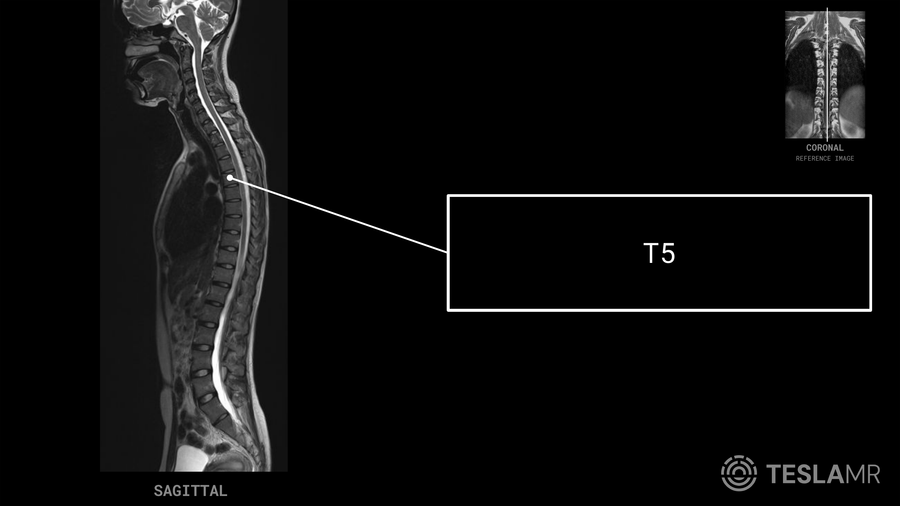
T5 labeled on a T-Spine MRI (Sagittal)

T5

The fifth thoracic vertebra in the mid-upper thoracic spine.

On MRI: Counted sequentially below T4; the nearby aortic arch and carina at T4 help verify that the count is on track at this level.

Common pathology: Mid-thoracic compression and metastases are localized by maintaining an accurate count from the upper landmarks.

T6 labeled on a T-Spine MRI (Sagittal)

T6

The sixth thoracic vertebra, approaching the middle of the thoracic spine.

On MRI: Identified by continuing the count downward; the mid-thoracic bodies are uniform, so the running tally is the reliable cue.

Common pathology: Mid-thoracic levels are a common location for osteoporotic compression fractures that need precise labeling.

T7 labeled on a T-Spine MRI (Sagittal)

T7

The seventh thoracic vertebra, lying at roughly the middle of the thoracic spine.

On MRI: Counted from above as the approximate mid-thoracic body; it is a useful mental midpoint when checking that a top-down and bottom-up count meet sensibly.

Common pathology: Mid-thoracic disc herniations and compression fractures are localized here, where labeling errors are most likely without a verified count.

T8 labeled on a T-Spine MRI (Sagittal)

T8

The eighth thoracic vertebra in the lower-middle thoracic spine.

On MRI: Identified by sequential counting; the lower thoracic bodies can also be confirmed by counting upward from L1 and T12.

Common pathology: Lower-middle thoracic compression and metastatic lesions are localized by cross-checking counts from both ends.

T9 labeled on a T-Spine MRI (Sagittal)

T9

The ninth thoracic vertebra in the lower thoracic spine.

On MRI: Counted either down from the upper landmarks or up from L1 and T12 on sagittal; agreement between the two counts confirms the level.

Common pathology: Lower thoracic compression fractures and metastases are common and depend on accurate level assignment.

T10 labeled on a T-Spine MRI (Sagittal)

T10

The tenth thoracic vertebra in the lower thoracic spine.

On MRI: Best confirmed by counting upward from the bottom landmarks since the conus and L1 are nearby and easy to anchor to.

Common pathology: The lower thoracic region near the conus is scrutinized for compression and for lesions affecting the cord as it tapers.

T11 labeled on a T-Spine MRI (Sagittal)

T11

The eleventh thoracic vertebra near the thoracolumbar junction; its rib is short and may be hard to see.

On MRI: Confirmed by counting up from T12 and L1 on sagittal; its rib articulation is small, so the running count is more reliable than rib spotting at this level.

Common pathology: The thoracolumbar region is a high-stress zone for traumatic and osteoporotic fractures, making correct T11 labeling important.

T12 labeled on a T-Spine MRI (Sagittal)

T12

The twelfth and lowest thoracic vertebra, bearing the last rib and forming the thoracolumbar junction with L1.

On MRI: The lowest rib-bearing body on sagittal, directly above L1; identifying the last rib confirms T12 and provides a reliable bottom anchor for the count.

Common pathology: The thoracolumbar junction (T12 to L1) is the single most common site of compression and burst fractures, so this level is confirmed carefully.

Tip: The lowest vertebra that carries a rib is T12; pair this with the conus tip and L1 to lock the bottom of the thoracic count.

Frequently asked questions

What structures are seen on a thoracic spine MRI?

A standard T-spine MRI shows the spinal cord and its tapered lower end (the conus medullaris), the surrounding CSF, and the twelve thoracic vertebral bodies (T1 through T12) with their discs. Counting landmarks such as C2, C7, and L1 are used to confirm each thoracic level. This page labels every structure in the deck on the sagittal plane.

Which plane is best for studying thoracic spine anatomy?

The sagittal is the workhorse plane for the thoracic spine: it shows the cord, the conus, and all the vertebral bodies and discs in a single view, which is exactly what you need for counting levels. Axial images are then used to evaluate the cord, neural foramina, and disc detail at a specific level.

How do you count thoracic levels accurately on MRI?

Start from a structure you can identify with certainty, then count sequentially. Common references are C2 (the dens) or C7 at the top and L1 or the conus tip at the bottom. T1 is the first rib-bearing body below C7 and T12 is the lowest rib-bearing body above L1. When a top-down and a bottom-up count agree, the levels are confirmed.

What sequences are typically used for a thoracic spine MRI?

A routine T-spine protocol usually pairs sagittal T1 and sagittal T2 with axial T2 through areas of interest, often adding STIR or another fat-suppressed sequence to highlight cord signal change, marrow edema, and fractures. CSF is dark on T1 and bright on T2, which makes the cord and conus easy to outline.

Do I need an account to use these T-Spine MRI flashcards?

No. The interactive flashcards and this full labeled reference are open to use, with no account required to start. Creating an account lets you save your progress across devices and track which packs you have mastered.

Tesla MR Institute

Training to become an MRI technologist?

These flashcards come from our MRI tech program — learn online and train at a clinical site near you, in 12 to 18 months.

Explore the program