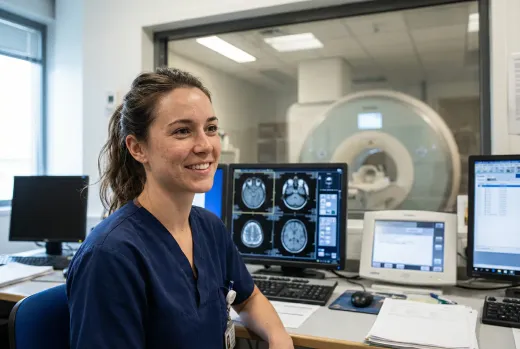
Four pathways into MRI serve Massachusetts students:
| Program | Duration | Prerequisites | Cost | Best For |
|---|---|---|---|---|
| Mass General Radiologic Technology | 2 years | Prerequisites required | Contact for tuition | Traditional pathway, Boston |
| MCPHS University | 2+ years | Prerequisites required | $35,000+ | Bachelor’s degree pathway |
| Quinsigamond CC (Worcester) | 2 years | Prerequisites required | $8,000-$12,000 | Affordable traditional pathway |
| Tesla MR Institute | 12-18 months | None (high school diploma/GED) | Starting at $11,500 | Career changers, no radiology background |
Massachusetts MRI techs earn $75,000-$110,000 depending on region, among the highest in the nation. The state has 25+ clinical training sites. The Boston metro in particular offers premium salaries driven by the concentration of world-class medical centers.
This guide covers program details, licensing, salary data by metro area, and clinical training site locations across Massachusetts.
Looking for city-specific information? Jump to Boston, Worcester, or Springfield programs.
Massachusetts MRI technologist licensing: what you need to know
Massachusetts regulates radiologic technologists through the Department of Public Health under 105 CMR 125.000. This licensing applies to professionals who use ionizing radiation, including X-ray, CT, and fluoroscopy operators.
MRI does not use ionizing radiation. It uses magnetic fields and radiofrequency pulses. This distinction matters because the Massachusetts radiologic technologist license is specifically tied to ionizing radiation use. MRI-only technologists who do not operate X-ray or CT equipment may fall outside the scope of this regulation.
That said, many MRI technologists in Massachusetts hold radiologic technology licenses because they entered MRI through the traditional ARRT pathway, which includes radiography training.
What Massachusetts employers actually require
National certification is the standard. The two options are ARRT and ARMRIT.
- Mass General Brigham (including Massachusetts General Hospital and Brigham and Women’s): Generally prefers ARRT, though some facilities evaluate ARMRIT candidates
- Beth Israel Deaconess / Lahey Health: Accepts both ARRT and ARMRIT
- UMass Memorial Health (Worcester): Accepts both certifications
- Baystate Health (Springfield): Accepts both certifications
- Outpatient imaging centers: Generally accept either certification
Massachusetts has some of the most prestigious hospitals in the world, and competition for positions at places like Mass General can be intense. However, the broader Massachusetts market, including community hospitals and outpatient centers, is accessible to ARMRIT-certified technologists.
Key Takeaway
Massachusetts licenses radiologic technologists who use ionizing radiation, but MRI-only positions may not require this state license. Employers require national certification (ARRT or ARMRIT). Both are accepted at most facilities, though top academic centers may prefer ARRT.
MRI tech programs in Massachusetts
Massachusetts General Hospital — Radiologic Technology Education
Mass General’s radiologic technology program is one of the most respected in the country. It prepares students for ARRT certification in radiography, after which they can pursue MRI as a post-primary specialty.
Key details:
- Duration: 2 years
- Prerequisite: College prerequisites (anatomy, physiology, etc.)
- Location: Boston (Massachusetts General Hospital)
- Outcome: Prepares for ARRT primary certification in radiography
- Strength: Clinical training at one of the top hospitals in the world
- Limitation: Radiography program, MRI requires additional post-primary work
MCPHS University
MCPHS (Massachusetts College of Pharmacy and Health Sciences) offers a radiography program with strong clinical affiliations across the Boston area.
Key details:
- Duration: 2+ years (bachelor’s degree track)
- Prerequisite: College prerequisites
- Location: Boston
- Cost: $35,000+ (private university)
- Strength: Bachelor’s degree, strong Boston clinical partnerships
- Limitation: MRI requires additional post-primary certification
Quinsigamond Community College (Worcester)
QCC offers a JRCERT-accredited radiologic technology program as an affordable pathway into imaging. MRI is available as a post-primary specialty after completing the radiography program.
Key details:
- Duration: 2 years for radiography
- Prerequisite: College prerequisites
- Location: Worcester
- Cost: $8,000-$12,000 (community college rates)
- Strength: Affordable, JRCERT accreditation, central Massachusetts location
- Limitation: Long pathway to MRI, requires completing radiography first
Tesla MR Institute (hybrid, statewide)
Tesla MR Institute’s program is designed for people entering MRI directly without needing to complete a radiography program first.
Key details:
- Duration: 12-18 months
- Prerequisite: None. No prior radiology credentials required.
- Format: Online didactic coursework combined with in-person clinical rotations at local Massachusetts sites
- Clinical sites in Massachusetts: 39 facilities across the state
- Certification: Prepares for ARMRIT certification
- Cost: Starting at $11,500 (full program, payment plans available)
- Strength: Accessible to career changers, flexible schedule, dramatically lower cost
- Limitation: Prepares for ARMRIT, not ARRT
Tip
Massachusetts is Tesla MR Institute’s sixth-largest student state with 18 active students. The state’s strong healthcare market and high MRI salaries make it an attractive place to start an MRI career, even through the ARMRIT pathway.
Choosing between ARRT and ARMRIT pathways
For a detailed side-by-side breakdown, read our ARRT vs ARMRIT comparison guide.
Choose the ARRT pathway if:
- You already hold ARRT certification in another modality
- You are targeting academic medical centers like Mass General or Brigham and Women’s
- You want maximum flexibility across all Massachusetts employers
Choose the ARMRIT pathway if:
- You do not have prior radiology credentials
- You are a career changer looking for the fastest, most affordable path into MRI
- You are willing to start at community hospitals or outpatient centers and build experience
MRI technologist salary in Massachusetts
Massachusetts offers some of the highest MRI technologist salaries in the country, driven by the concentration of academic medical centers and the high cost of living in the Boston metro area.
Salary by region
| Region | Mean Annual Wage | Mean Hourly Wage | Notes |
|---|---|---|---|
| Boston-Cambridge-Newton | $90,000-$110,000 | $43-$53 | Highest paying, most positions |
| Worcester | $82,000-$95,000 | $39-$46 | Second largest market |
| Springfield-Holyoke | $75,000-$88,000 | $36-$42 | Western MA, lower COL |
| Cape Cod / South Shore | $80,000-$92,000 | $38-$44 | Seasonal demand variations |
| Lowell-Lawrence | $82,000-$95,000 | $39-$46 | Northern MA |
Source: Bureau of Labor Statistics, Occupational Employment and Wage Statistics.
For Boston-specific salary data, employer lists, and clinical site details, see our Boston MRI tech programs guide. Worcester-area students can find local program details in our Worcester guide, and western Massachusetts students should check our Springfield guide.
Salary by experience level
Entry-level MRI technologists in Massachusetts typically start between $70,000 and $82,000. With 3-5 years of experience and specialty skills (cardiac MRI, breast MRI, neuroimaging), salaries commonly reach $95,000-$115,000. Travel MRI techs working Massachusetts assignments can earn $2,800-$3,800 per week, among the highest travel rates in the country.
For a deeper dive into MRI tech compensation, see our MRI technologist salary guide and salary by state breakdown.
Clinical training sites in Massachusetts
Tesla MR Institute has 25+ clinical training sites across Massachusetts, concentrated in the Boston metro area, Worcester, and throughout eastern Massachusetts.
Partner facilities include hospital systems, outpatient imaging centers, and radiology groups. The Boston area has the densest concentration of sites, though central and western Massachusetts also have clinical training options.
Most Massachusetts students are placed within 30-45 minutes of their home. Students in the Boston metro typically have multiple site options to choose from.
Employer Tip
If you are a facility manager in Massachusetts interested in hosting MRI training students, Tesla MR Institute partners with hospitals and imaging centers across the state. Hosting students gives you a direct pipeline to trained, certified MRI technologists. See our clinical site partnership page for details.
Tesla MR Institute has 25+ clinical sites across Massachusetts. Train locally while completing coursework online.
How to become an MRI tech in Massachusetts: step by step
Path 1: Career changers and new entrants (ARMRIT)
- Confirm eligibility. You need a high school diploma or GED. Healthcare experience is preferred but not required.
- Enroll in an ARMRIT-approved program. Tesla MR Institute’s hybrid program lets you complete didactic coursework online while doing clinical rotations at a Massachusetts facility.
- Complete clinical hours. You will log supervised clinical training at one of 39 Massachusetts sites.
- Pass the ARMRIT exam. After completing your program and clinical requirements, you sit for the ARMRIT certification exam.
- Apply for jobs. Your ARMRIT certification is your credential. You may not need a Massachusetts radiologic technology license for MRI-only positions.
Path 2: Existing rad techs (ARRT post-primary)
- Confirm ARRT eligibility. You need current ARRT certification in a primary pathway.
- Complete post-primary MRI requirements. This can be done through employer-sponsored clinical experience or structured education programs.
- Pass the ARRT MRI exam. This is the post-primary MRI specialty exam administered by ARRT.
- Maintain Massachusetts license if applicable. If you hold a Massachusetts radiologic technology license, keep it current through continuing education.
For a broader look at MRI tech requirements across all states, see our state-by-state guide.
Massachusetts MRI tech job market
Massachusetts has one of the strongest MRI job markets in the country, driven by:
1. Academic medical center density. Greater Boston has Mass General, Brigham and Women’s, Beth Israel Deaconess, Tufts Medical Center, Boston Children’s, Dana-Farber Cancer Institute, and more. Each operates multiple MRI scanners, often including high-field research magnets.
See our Boston MRI programs guide for a deeper look at the Boston-area job market and employer landscape.
2. Research imaging demand. Massachusetts’ concentration of medical research institutions creates demand beyond clinical care. Research MRI positions at places like the Athinoula A. Martinos Center at MGH or the neuroimaging labs at MIT require skilled technologists and often pay premium rates.
3. Aging New England population. The broader New England demographic trends toward older populations, driving increased demand for diagnostic imaging across the region.
The practical result: Massachusetts offers excellent career prospects for MRI technologists at all experience levels, with the Boston metro providing the most opportunities and highest compensation.
Cost of MRI tech programs in Massachusetts
| Program | Approximate Cost | Duration | Prerequisites |
|---|---|---|---|
| Mass General Radiologic Technology | Contact for tuition | 2 years | College prerequisites |
| MCPHS University | $35,000+ | 2+ years | College prerequisites |
| Quinsigamond CC | $8,000-$12,000 | 2 years | College prerequisites |
| Tesla MR Institute | under $13,000 (payment plans available) | 12-18 months | None |
For a detailed cost breakdown across different program types, see our guide on MRI tech school costs.
MRI programs by city in Massachusetts
Looking for MRI training in a specific Massachusetts city? See our detailed guides:
More resources
- How to become an MRI technologist covers every step from zero experience to your first job
- MRI technologist salary guide breaks down pay by state, setting, and experience level
- MRI technologist requirements explains what employers verify during hiring
- ARRT vs ARMRIT certification helps you choose the right credential path
Next steps
- Research your pathway. Decide between ARRT and ARMRIT. Our ARRT vs ARMRIT guide breaks down the tradeoffs.
- Check clinical site availability. Tesla MR has 39 Massachusetts sites, but availability varies by semester. Apply early.
- Talk to your employer. If you are currently working in healthcare, ask about tuition sponsorship.
- Review compensation data. Massachusetts MRI tech salaries are among the highest in the country. See our full MRI technologist salary guide for negotiation context.
- Compare all state options. If you are flexible on location, our state-by-state MRI tech guide covers licensing, salary, and program options for every state.
- Apply. Tesla MR Institute accepts rolling applications with no application fee. Start your application →