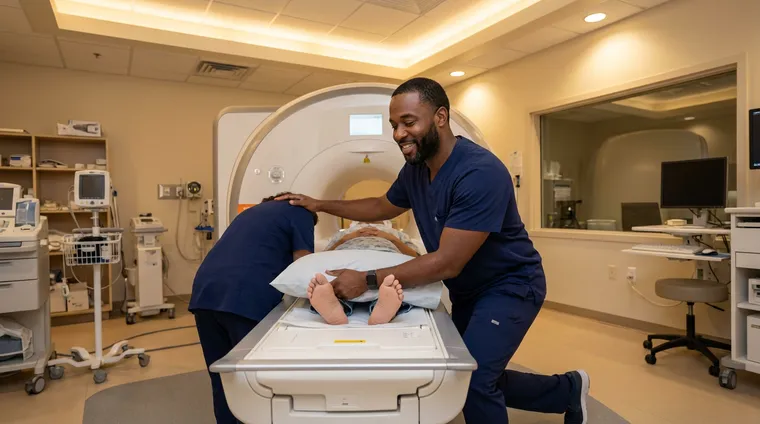
Definition
MRI safety screening is the process of verifying that a patient has no implants, devices, metal objects, or conditions that would make MRI scanning unsafe. It occurs before every patient enters the MRI environment.
The core principle: MRI magnets are always on. The magnetic field can turn ferromagnetic objects into projectiles, cause implants to malfunction or shift, and create burns through heating. Screening identifies and addresses these risks before they cause harm.
This is not a formality—it’s the highest-stakes responsibility MRI technologists carry.
What MRI Safety Screening Covers
Implants and Devices
Cardiac devices:
- Pacemakers (many are now MRI-conditional with specific protocols)
- Defibrillators (ICDs)
- Loop recorders
- Artificial heart valves
Neurological devices:
- Cochlear implants
- Deep brain stimulators
- Neurostimulators
- Aneurysm clips
- Shunts
Orthopedic hardware:
- Joint replacements
- Plates, screws, rods
- Spinal fusion hardware
- External fixation devices
Other implants:
- Insulin pumps
- Pain pumps
- Tissue expanders
- Breast implants
- Eye implants
- Penile implants
Metal Foreign Bodies
High-risk situations:
- Metalworkers (grinding, welding)
- Military personnel (shrapnel)
- Eye injuries involving metal fragments
- Gunshot wound history
Verification methods:
- X-ray screening for orbital metal if history suggests risk
- Documentation review
- Detailed patient questioning
Other Considerations
Pregnancy:
- First trimester often avoided unless clinically necessary
- Contrast administration decisions involve additional considerations
Contrast contraindications:
- Renal function assessment for gadolinium
- Prior contrast reactions
- Allergies
Claustrophobia and anxiety:
- Not a safety contraindication but affects scan completion
- May require additional preparation or sedation
The Screening Process
Step 1: Questionnaire Review
Patients complete written screening forms covering:
- Medical/surgical history
- Implanted devices
- Metal exposure history
- Medications
- Allergies
- Pregnancy status
Step 2: Verbal Verification
The written form is the starting point, not the finish. Technologists must:
- Review answers with the patient
- Ask clarifying questions about flagged items
- Probe for information patients might not know to mention
- Watch for inconsistencies between written and verbal responses
Step 3: Documentation Review
When implants or devices are identified:
- Review medical records for device information
- Identify manufacturer, model, and MRI status
- For conditional devices, verify specific scanning conditions
Step 4: Escalation When Needed
If information is unclear or risk is elevated:
- Consult with radiologist
- Contact patient’s physician
- Obtain device manufacturer specifications
- Do not proceed until safety is confirmed
Step 5: Final Check
Before patient enters scan room:
- Final verbal confirmation
- Remove all metal objects (jewelry, clothing with metal, etc.)
- Metal detection wand if available
- Patient empties pockets
MRI Safety Zones
Most facilities use a zone system for MRI safety:
| Zone | Description | Access |
|---|---|---|
| Zone I | General public area (waiting room) | Unrestricted |
| Zone II | Interface between public and controlled (reception) | Semi-restricted |
| Zone III | Screened-only area (control room, prep areas) | Only screened individuals |
| Zone IV | MRI scanner room | Only screened individuals under supervision |
Maintaining zone integrity prevents unauthorized or unscreened individuals from entering the magnetic field.
Why Screening Errors Are Catastrophic
Projectile incidents: Ferromagnetic objects (oxygen tanks, wheelchairs, tools, weapons) have caused deaths and serious injuries when brought into Zone IV.
Device malfunction: Pacemakers and other devices can malfunction in the magnetic field, potentially causing cardiac arrest or other emergencies.
Burns: Heating of certain implants or objects in contact with skin can cause severe burns.
Device movement: Some older devices or improperly screened implants can shift within the body.
The stakes: These incidents are largely preventable through proper screening. When they occur, they represent screening failures.
Good Screening Habits
Always
- Review forms carefully. don’t skim
- Ask follow-up questions
- Verify unclear information before proceeding
- Treat every screening as important (even “routine” patients)
- Document screening thoroughly
Never
- Assume a patient is safe because they “look fine”
- Rush screening to stay on schedule
- Take patient statements at face value without verification when something seems off
- Proceed when uncertain
When in Doubt
Stop. Escalate. Verify. The schedule can wait.
Related Reading
Frequently Asked Questions
MRI uses powerful magnetic fields (1.5–3+ Tesla). Ferromagnetic objects can become high-velocity projectiles. Some implants can malfunction, shift, or heat. The consequences of screening errors can be catastrophic, including serious injury or death.
You stop and verify. The correct approach is to confirm device compatibility through documentation, manufacturer information, or radiologist/physician consultation. Never proceed when uncertain.
Core principles are consistent (identifying contraindications), but specific procedures, forms, and escalation protocols vary by facility. Always follow your site's specific policies.
Treating screening as a form to complete rather than a safety decision. Good screening is active. asking follow-up questions, watching for inconsistencies, and maintaining judgment even when patients seem routine.
Thorough screening takes time, but safety incidents and repeat scans cost far more. Good screening actually improves efficiency by preventing problems.