Definition
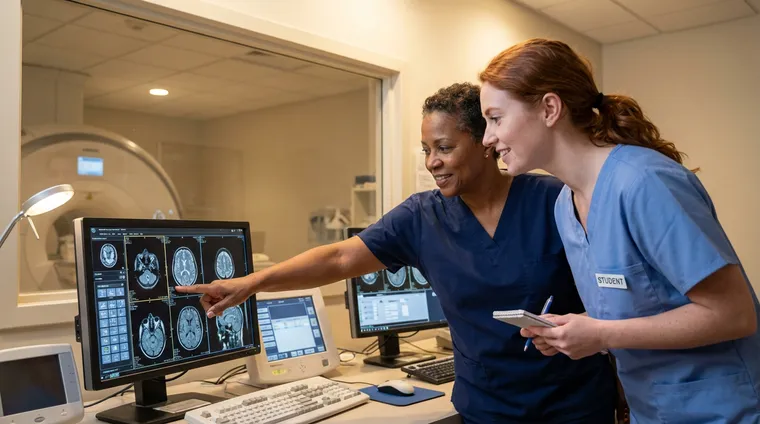
MRI tech school refers to training programs that prepare students to become MRI technologists. These programs combine:
- Didactic education: MRI safety, anatomy, physics, protocols, patient care
- Clinical training: Supervised hands-on experience at real imaging sites
- Exam prep: Preparation for ARRT or ARMRIT credentialing exams
Completing MRI tech school makes you eligible to sit for the registry exam and begin working as a credentialed MRI technologist.
Types of MRI Tech Schools
MRI-Specific Certificate Programs
What they are: Focused programs designed specifically for MRI training
Typical structure:
- 12–18 months total
- Online coursework + in-person clinical
- 750–1,000+ clinical hours
- ARMRIT exam preparation
Cost range: $11,000–$15,000
Best for: Career changers entering MRI without prior radiologic technology credentials (including those already working in healthcare like medical assistants, patient care techs, and nurses)
Example: Tesla MR (12–18 months, 1,000 clinical hours, ARMRIT pathway)
Community College Programs
What they are: MRI programs offered through community colleges, sometimes as part of broader radiologic technology curriculum
Typical structure:
- May be certificate or associate degree
- Variable clinical arrangements
- May include general education requirements
Cost range: $8,000–$15,000 (varies by residency)
Best for: Students who want academic credit structure
University Programs
What they are: Four-year programs with MRI specialization
Typical structure:
- Bachelor’s degree with MRI track
- Longer timeline (2–4 years)
- More comprehensive academic curriculum
Cost range: $15,000–$30,000+
Best for: Students who want a bachelor’s degree alongside MRI credentials
What MRI Tech School Includes
Didactic Component (Education)
| Topic Area | What You Learn |
|---|---|
| MRI Safety | Screening, zones, contraindications, emergency procedures |
| Anatomy | Cross-sectional anatomy for MRI interpretation |
| Physics | Basic MRI physics, enough to understand image formation |
| Protocols | Standard imaging sequences by body region |
| Patient Care | Communication, positioning, managing patient anxiety, contrast administration |
| Image Quality | Artifacts, troubleshooting, quality assessment |
Clinical Component (Training)
| Requirement | Typical Details |
|---|---|
| Total hours | 750–1,000+ hours |
| Duration | 6–9 months at 16–24 hours/week |
| Setting | Hospital MRI, outpatient imaging, specialty clinics |
| Supervision | Working alongside credentialed MRI technologists |
Exam Prep Component
- Content review aligned with registry exam
- Practice questions and mock exams
- Study resources and support
Choosing the Right MRI Tech School
Questions to Ask
About clinical placement:
- “Where do students complete clinical?”
- “How many clinical sites do you have?”
- “Who is responsible for finding clinical sites?”
- “What happens if a site falls through?”
About outcomes:
- “What’s the average time to completion?”
- “What credential does your program prepare for?”
- “What exam prep support do you provide?”
About costs:
- “What’s included in tuition?”
- “What additional costs should I budget for?”
- “Are payment plans available?”
Red Flags
❌ Vague clinical placement answers ❌ Claims of “100% online” without clarifying clinical requirements ❌ No clear credential pathway ❌ Inability to answer outcome questions
Green Flags
✅ Specific clinical site network (named partnerships, concrete numbers) ✅ Clear timeline and structure ✅ Transparent about what’s included and what’s not ✅ Strong answers about support when problems arise
MRI Tech School Cost Summary
| Cost Category | Range |
|---|---|
| Tuition | $8,000–$20,000 |
| Compliance (background, immunizations) | $400–$1,000 |
| Clinical commute (6–9 months) | $600–$2,500 |
| Exam fee | $225–$300 |
| Total | $9,225–$23,800 |
Related: How much does MRI tech school cost?
Related Reading
Frequently Asked Questions
The coursework portion can be online, but clinical training is always in-person. You'll spend 750–1,000+ hours at real imaging sites. Any program implying fully remote MRI training is misleading.
Most dedicated MRI programs take 12–18 months. Timeline depends on clinical scheduling and whether you're a career changer or building on existing credentials.
Focus on clinical placement support. not just tuition. Ask where students train, who secures sites, what happens if sites fall through, and what the average time to completion is.
Tuition typically ranges $8,000–$20,000 depending on program type. Add $1,000–$2,500 for compliance costs, clinical commute, and exam fees. Total investment: $12,000–$22,000.
Vague answers about clinical placement. If a program can't clearly explain where and how you'll complete clinical hours, assume you'll be figuring it out alone.