All body parts
MRI Anatomy Flashcards · Body

Prostate Anatomy

Learn to identify every labeled structure on a Prostate MRI, plane by plane.

Studying as a guest, so progress saves on this device only.

Prostate anatomy, structure by structure

Prostate MRI, often run as a multiparametric exam (mpMRI), is built around high-resolution T2 imaging in the axial and sagittal planes, supported by diffusion and dynamic contrast. Reading it starts with knowing the zonal anatomy of the gland and the pelvic organs packed around it. This reference walks through every structure in our prostate flashcard deck, with a plain-language definition, how each one looks on MRI, and the pathology you will actually encounter at the scanner.

Prostate zones

The gland is divided into zones that behave very differently on T2. The peripheral zone is bright and is where most cancers hide as dark spots; the transition zone is where benign enlargement (BPH) arises.

Prostate labeled on a Prostate MRI (Axial · Sagittal)

Prostate

The walnut-sized gland that sits below the bladder and surrounds the prostatic urethra, contributing fluid to semen.

On MRI: Centered below the bladder base and in front of the rectum; best evaluated on small field-of-view axial and sagittal T2. The peripheral zone is bright while the central gland is more heterogeneous and intermediate to dark.

Common pathology: Prostate cancer, benign prostatic hyperplasia, and prostatitis are the main reasons a dedicated prostate MRI is ordered.

Tip: On axial T2 the bright crescent of peripheral zone wrapping the back and sides of the gland tells you which way is posterior.

Peripheral Zone labeled on a Prostate MRI (Axial · Sagittal)

Peripheral Zone

The outer, posterior and lateral part of the gland that makes up most of its volume and is the most common site of prostate cancer.

On MRI: Uniformly bright (high signal) on T2, forming a crescent along the back and sides of the gland on axial and the posterior gland on sagittal.

Common pathology: About 70 to 80 percent of prostate cancers arise here and appear as focal low-T2 signal with restricted diffusion against the bright background.

Tip: Any rounded dark focus interrupting the normally bright peripheral zone deserves attention; that contrast is the whole point of T2 imaging.

Central Zone labeled on a Prostate MRI (Axial · Sagittal)

Central Zone

The cone of glandular tissue near the base that surrounds the ejaculatory ducts as they course toward the urethra.

On MRI: Low-to-intermediate signal on T2, sitting toward the base of the gland and best seen on axial and sagittal images near the seminal vesicles.

Common pathology: An uncommon origin for cancer; its normally low signal can mimic disease, so it is judged together with the transition and peripheral zones.

Transition Zone labeled on a Prostate MRI (Axial · Sagittal)

Transition Zone

The inner zone surrounding the prostatic urethra; it is small in young men but enlarges with age.

On MRI: Heterogeneous on T2 with mixed bright and dark nodules as benign hyperplasia develops; sits centrally around the urethra on axial and sagittal.

Common pathology: The site of benign prostatic hyperplasia (BPH); transition-zone cancers are harder to call and often show an ill-defined dark lensed shape rather than a discrete nodule.

Adjacent pelvic organs

The organs immediately around the gland. The rectum behind and the bladder above are the constant landmarks; bowel loops drift in from above.

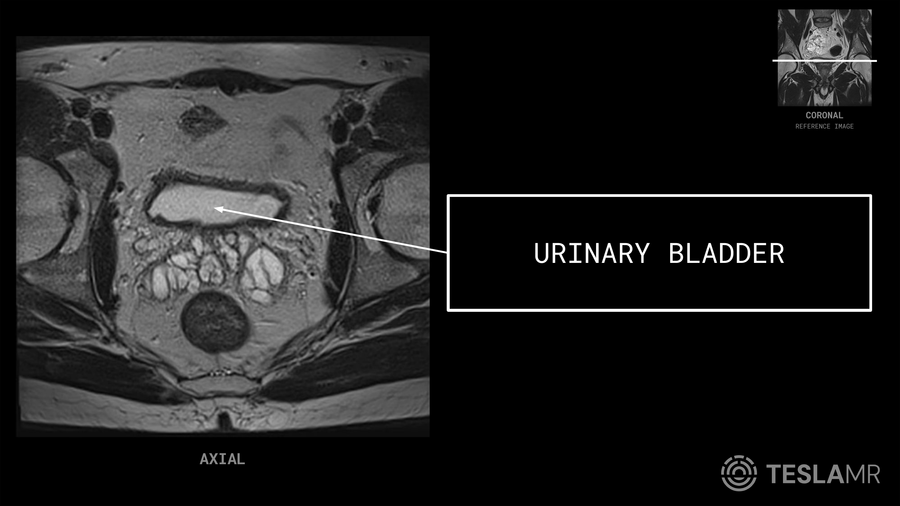
Urinary Bladder labeled on a Prostate MRI (Axial)

Urinary Bladder

The muscular reservoir that stores urine, sitting directly above the prostate.

On MRI: When filled, the urine is dark on T1 and bright on T2; the bladder forms a large fluid-filled space above the gland on axial and sagittal.

Common pathology: Bladder wall thickening from outlet obstruction, diverticula, and tumor at the base near the prostate.

Tip: A moderately full bladder helps; an overfull bladder causes motion and pelvic discomfort that degrade the small field-of-view images.

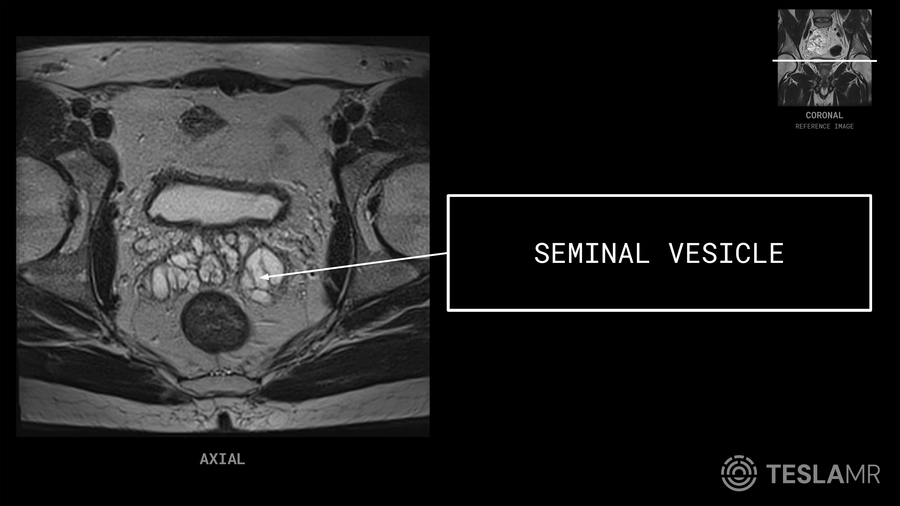
Seminal Vesicle labeled on a Prostate MRI (Axial · Sagittal)

Seminal Vesicle

The paired, sacculated glands behind the bladder and above the prostate that contribute fluid to semen.

On MRI: Grape-like cystic clusters that are very bright on T2, sitting behind the bladder and above the gland on axial and sagittal.

Common pathology: Seminal vesicle invasion by prostate cancer (an important staging finding) shows as loss of the normal bright signal and thickened walls.

Rectum labeled on a Prostate MRI (Axial · Sagittal)

Rectum

The terminal segment of the large bowel, lying directly behind the prostate.

On MRI: A tube immediately posterior to the gland; its contents vary, and gas or stool here is a common source of artifact on diffusion images.

Common pathology: Rectal gas distortion is the technologist's main concern, since it degrades diffusion of the adjacent peripheral zone; rectal wall disease is also assessed.

Tip: Have the patient empty the rectum beforehand when possible; rectal gas right behind the gland is the classic cause of nondiagnostic diffusion.

Anal Canal labeled on a Prostate MRI (Sagittal)

Anal Canal

The short final passage of the bowel between the rectum and the anus, ringed by the sphincter muscles.

On MRI: A narrow midline canal below the rectum on sagittal, surrounded by the muscular sphincter complex.

Common pathology: Perianal fistulas and abscesses and anal sphincter integrity are evaluated, usually on dedicated pelvic protocols.

Anus labeled on a Prostate MRI (Sagittal)

Anus

The external opening at the lower end of the anal canal where the bowel terminates.

On MRI: The most inferior point of the bowel on midline sagittal, marking the lower end of the canal at the skin surface.

Common pathology: Mainly an anatomic landmark on prostate imaging; perianal fistula tracks and skin-level disease can involve it.

Sigmoid Colon labeled on a Prostate MRI (Sagittal)

Sigmoid Colon

The S-shaped segment of large bowel above the rectum that loops into the upper pelvis.

On MRI: A bowel loop in the upper pelvis above the rectum on sagittal; its contents and peristalsis vary from study to study.

Common pathology: Diverticular disease and bowel peristalsis artifact; antispasmodics may be used to reduce motion on pelvic exams.

Small Intestine labeled on a Prostate MRI (Sagittal)

Small Intestine

The loops of small bowel that descend into the upper pelvis above the bladder.

On MRI: Mobile fluid- and gas-filled loops in the upper pelvis above the bladder on sagittal; signal varies with their contents.

Common pathology: Chiefly a source of peristalsis and gas artifact over the prostate field; antispasmodic medication is sometimes given to quiet it.

Male perineum and external genitalia

The structures below and in front of the gland, best traced on the midline sagittal as it runs down to the penis and scrotum.

Scrotum labeled on a Prostate MRI (Sagittal)

Scrotum

The skin pouch below the penis that holds the testes.

On MRI: A soft-tissue sac at the bottom of the field on sagittal, containing the testes within fluid that is bright on T2.

Common pathology: Hydrocele, scrotal masses, and inflammation; dedicated scrotal MRI is its own protocol separate from the prostate.

Testis labeled on a Prostate MRI (Sagittal)

Testis

The paired male gonad inside the scrotum that produces sperm and testosterone.

On MRI: An oval structure of fairly uniform, intermediate-to-bright T2 signal within the scrotum on sagittal.

Common pathology: Testicular tumors, torsion, and undescended (cryptorchid) testes; a focal signal change in the testis is the key finding.

Corpus Spongiosum Penis labeled on a Prostate MRI (Sagittal)

Corpus Spongiosum Penis

The midline erectile column on the underside of the penis that surrounds and protects the urethra.

On MRI: A midline cord of bright T2 erectile tissue beneath the paired corpora cavernosa on sagittal, carrying the urethra.

Common pathology: Mainly an anatomic landmark on prostate studies; urethral and erectile-tissue disease is assessed on dedicated penile MRI.

Corpus Cavernosum Penis labeled on a Prostate MRI (Sagittal)

Corpus Cavernosum Penis

The paired erectile columns forming the bulk of the penile shaft on its upper aspect.

On MRI: Paired columns of bright T2 erectile tissue making up the top of the shaft, lying above the corpus spongiosum on sagittal.

Common pathology: Penile fibrosis (Peyronie disease), fracture, and infiltration are evaluated on dedicated penile protocols rather than routine prostate imaging.

Bony pelvis landmarks

The fixed bone landmarks that anchor your orientation. Marrow-containing bone is bright on T1; the pubis sits in front of the gland and the sacrum and coccyx behind.

Left Femoral Head labeled on a Prostate MRI (Axial)

Left Femoral Head

The ball-shaped top of the left thigh bone that fits into the hip socket on the left side of the pelvis.

On MRI: A rounded ball of fatty marrow, bright on T1, seated in the acetabulum on the patient's left on axial images.

Common pathology: Avascular necrosis and marrow signal change; on prostate exams the femoral heads are a useful left-right orientation check and can house metastatic deposits.

Tip: Use the labeled left femoral head to confirm patient orientation before you call anything lateralized in the gland.

Body of Pubis labeled on a Prostate MRI (Sagittal)

Body of Pubis

The front part of the pubic bone that meets its partner at the midline pubic symphysis, sitting just in front of the prostate.

On MRI: A block of fatty marrow, bright on T1, at the front of the pelvis directly anterior to the gland on sagittal.

Common pathology: Osteitis pubis and marrow edema; its marrow can also harbor metastases from prostate cancer.

Sacrum labeled on a Prostate MRI (Sagittal)

Sacrum

The triangular bone at the back of the pelvis formed by fused vertebrae, sitting behind the rectum.

On MRI: A fatty-marrow triangle, bright on T1, at the back of the midline sagittal behind the rectum, tapering down to the coccyx.

Common pathology: Sacral insufficiency fractures and metastases; sacral marrow is a frequent site of bony spread from prostate cancer.

Coccyx labeled on a Prostate MRI (Axial · Sagittal)

Coccyx

The small tailbone at the very bottom of the spine, below the sacrum.

On MRI: The short curved segment continuing below the sacrum on midline sagittal; a small bony fleck behind the rectum on axial.

Common pathology: Coccydynia and post-traumatic deformity; mainly a posterior landmark on pelvic and prostate imaging.

Frequently asked questions

What planes and sequences are used for a prostate MRI?

A standard multiparametric prostate MRI (mpMRI) is built around high-resolution T2-weighted imaging in the axial and sagittal planes (often coronal too), plus diffusion-weighted imaging with ADC maps and dynamic contrast-enhanced T1. T2 defines the zonal anatomy, diffusion highlights suspicious tissue, and contrast adds vascular information.

Why is the peripheral zone bright on T2 and why does that matter?

The peripheral zone is glandular tissue that holds a lot of fluid, so it is uniformly bright on T2. Because most prostate cancers arise there and appear as dark, rounded foci, the bright background makes those lesions stand out. Preserving good T2 contrast and avoiding artifact over the gland is central to a diagnostic study.

What are the key landmarks around the prostate on MRI?

The bladder sits directly above the gland, the rectum lies immediately behind it, and the seminal vesicles tuck in behind the bladder above the base. The pubis is in front and the sacrum and coccyx are behind. The labeled left femoral head is a quick way to confirm left-right orientation before describing anything as lateralized.

How do technologists reduce rectal gas and motion artifact on prostate MRI?

Rectal gas directly behind the gland distorts the diffusion images of the peripheral zone, so emptying the rectum before the exam helps. Quieting bowel peristalsis with an antispasmodic when indicated, and a moderately (not overly) full bladder, also improve the small field-of-view T2 and diffusion images.

Do I need an account to use these Prostate MRI flashcards?

No. The interactive flashcards and this full labeled reference are open to use, with no account required to start. Creating an account lets you save your progress across devices and track which packs you have mastered.

Tesla MR Institute

Training to become an MRI technologist?

These flashcards come from our MRI tech program — learn online and train at a clinical site near you, in 12 to 18 months.

Explore the program